
Confrontation Theme of Second IGA Forum
Title
Confrontation Theme of Second IGA Forum
Subject
Faculty Speakers at WCU's second IGA meeting that was used a a "confrontational political device during the sixties."
Description
Faculty Speakers at WCU's second IGA meeting that was used a a "confrontational political device during the sixties." This article also highlights on a political persuasive speech Dr. Micheal Kay gave to both students and faculty.
Source
Quad Angels
Publisher
Special Collections, Francis Harvey Green Library, West Chester University
Date
November 11, 1969
Contributor
Olivia Smith
Rights
Digital images in Library Services’ Digital Collections are issued by Special Collections, Francis Harvey Green Library, West Chester University. Images are provided for non-commercial, educational, and personal use only, and are not intended for reproduction or redistribution. For the above purposes the user may reproduce these materials (by download, printing, etc.) without further permission, on the condition that proper attribution of the source for all copies is provided by clearly acknowledging the name of the Library, the title of the web page or resource and the URL at which it was located, please credit as follows: Special Collections, Francis Harvey Green Library, West Chester University, West Chester, Pennsylvania. For questions regarding use of digital materials contact Special Collections (libspeccol@wcupa.edu or 610-436-3456).
Identifier
https://digital.klnpa.org/digital/collection/wcnp01/id/13821/rec/4
Text
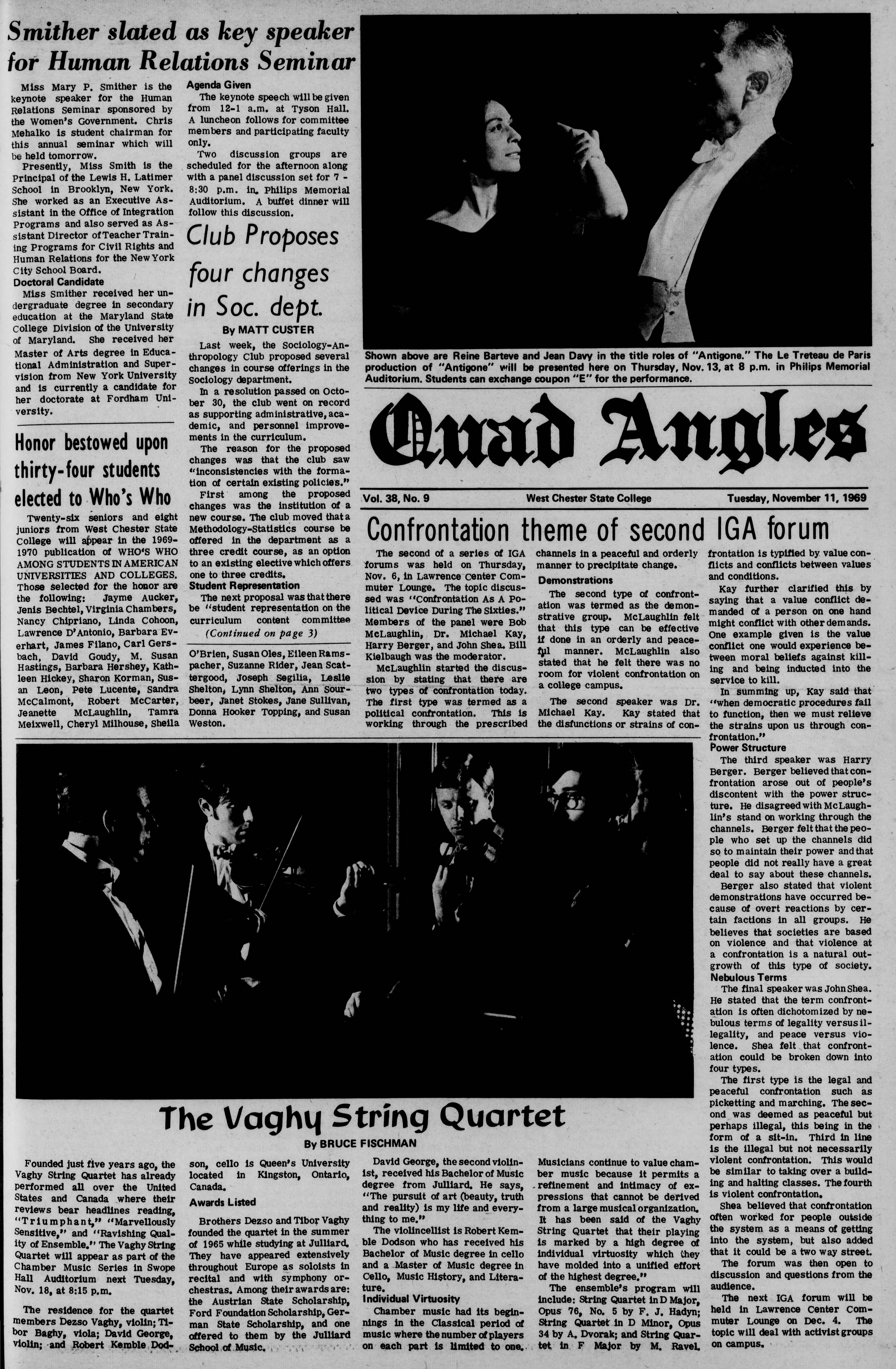
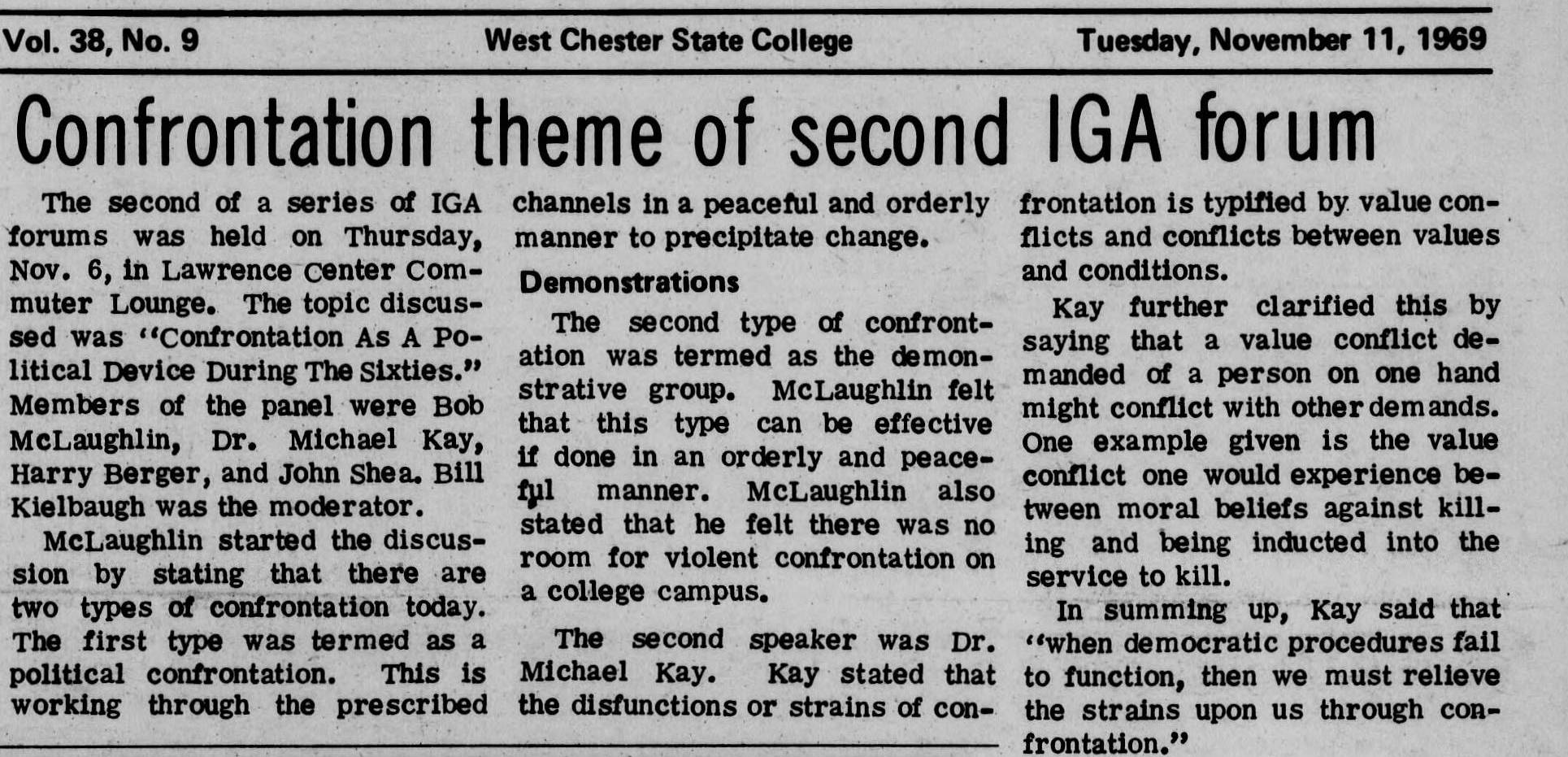
Confrontation theme of second IGA forum The second of a series of IGA forums was held on Thursday, Nov. 6, In Lawrence center Commuter Lounge. The topic discussed was "Confrontation As A Political Device During The sixties." Members of the panel were Bob McLaughlin, Dr. Michael Kay, Harry Berger, and John shea. Bill Kielbaugh was the moderator. McLaughlin started the discussion by stating that there are two types of confrontation today. The first type was termed as a political confrontation. This is working through the prescribed channels in a peaceful and orderly manner to precipitate change. Demonstrations The second type of confrontation was termed as the demonstrative group. McLaughlin felt that this type can be effective if done in an orderly and peaceful manner. McLaughlin also stated that he felt there was no room for violent confrontation on a college campus. The second speaker was Dr. Michael Kay. Kay stated that the disfunctions or strains of confrontationconfrontation is typified by value conflicts and conflicts between values and conditions. Kay further clarified this by saying that a value conflict demanded of a person on one hand might conflict with other demands. One example given is the value conflict one would experience between moral beliefs against killing and being inducted into the service to kill. In summing up, Kay said that "when democratic procedures fail to function, then we must relieve the strains upon us through confrontation."Power Structure The third speaker was Harry Berger. Berger believed that confrontation arose out of people's discontent with the power structure. He disagreed with McLaughlin's stand on working through the channels. Berger felt that the people who set up the channels did so to maintain their power and that people did not really have a great deal to say about these channels. Berger also stated that violent demonstrations have occurred because of overt reactions by certain factions in all groups. He believes that societies are based on violence and that violence at a confrontation is a natural outgrowth of this type of society. Nebulous Terms The final speaker was John Shea. He stated that the term confrontation is often dichotomized by nebulous terms of legality versus illegality, and peace versus violence. Shea felt that confrontation could be broken down into four types. The first type is the legal and peaceful confrontation such as picketting and marching. The second was deemed as peaceful but perhaps illegal, this being in the form of a sit-in. Third in line is the illegal but not necessarily violent confrontation. This would be similar to taking over a building and halting classes. The fourth is violent confrontation. Shea believed that confrontation often worked for people outside the system as a means of getting into the system, but also added that it could be a two way street. The forum was then open to discussion and questions from the audience. The next IGA forum will be held in Lawrence center commuter Lounge on Dec. 4. The topic will deal with activist groups on campus.
Files
Reference
1969, Confrontation Theme of Second IGA Forum, Special Collections, Francis Harvey Green Library, West Chester University