
Dr. Kay "Law and Order" could mean violent oppression
Title
Dr. Kay "Law and Order" could mean violent oppression
Subject
West Chester's English Department's "Coffee Hour," sparks the topic of black oppression and the black dilemma.
Description
West Chester's English Department's "Coffee Hour," sparks the topic of black oppression and the black dilemma. Professor Dr. Kay leads the conversation, suggesting white people should "stay out of black problems."
Source
The Quad
Publisher
Special Collections, Francis Harvey Green Library, West Chester University
Date
November 5, 1968
Contributor
Olivia Smith
Rights
Digital images in Library Services’ Digital Collections are issued by Special Collections, Francis Harvey Green Library, West Chester University. Images are provided for non-commercial, educational, and personal use only, and are not intended for reproduction or redistribution. For the above purposes the user may reproduce these materials (by download, printing, etc.) without further permission, on the condition that proper attribution of the source for all copies is provided by clearly acknowledging the name of the Library, the title of the web page or resource and the URL at which it was located, please credit as follows: Special Collections, Francis Harvey Green Library, West Chester University, West Chester, Pennsylvania. For questions regarding use of digital materials contact Special Collections (libspeccol@wcupa.edu or 610-436-3456).
Identifier
https://digital.klnpa.org/digital/collection/wcnp01/id/13584
Text
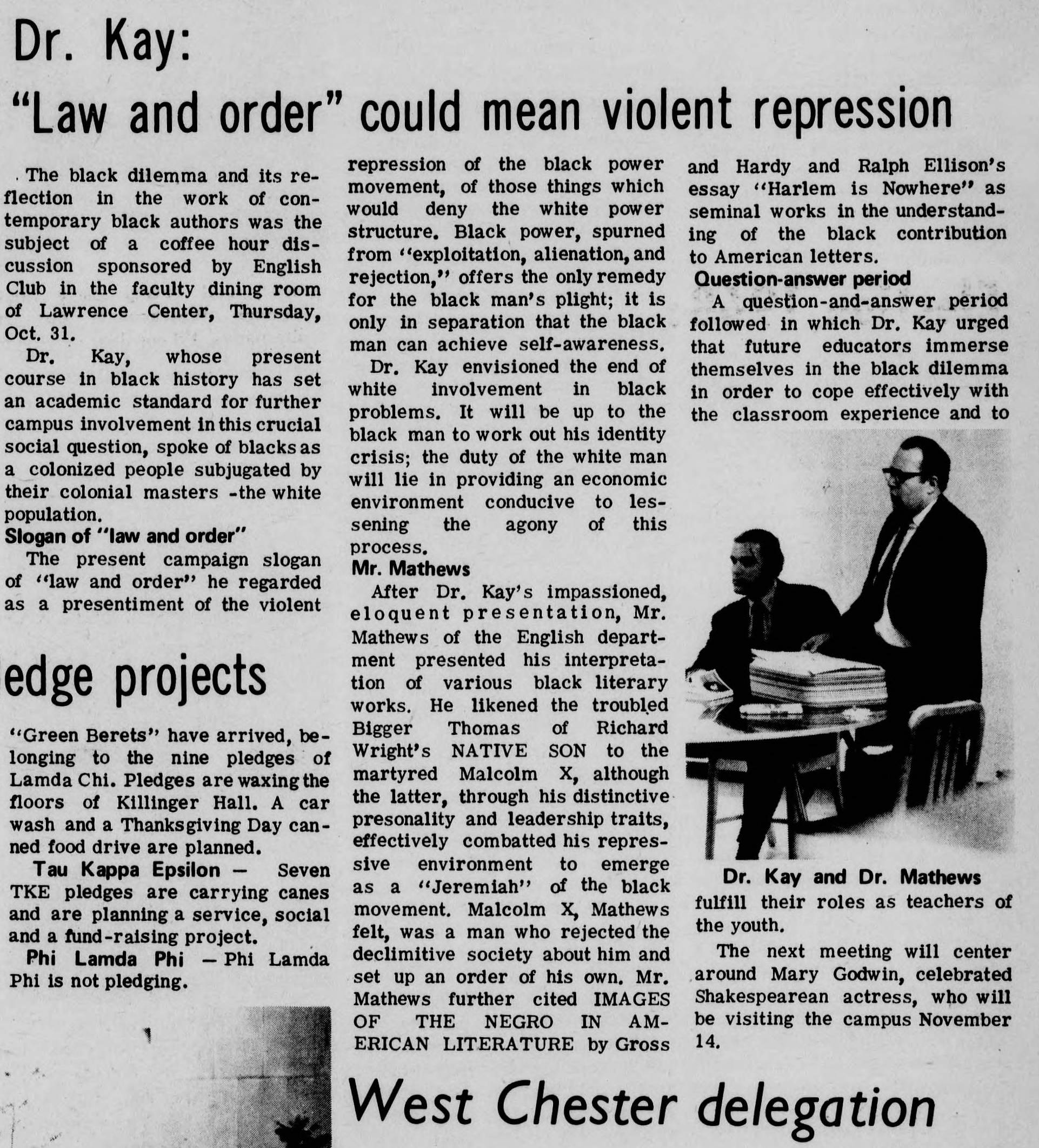
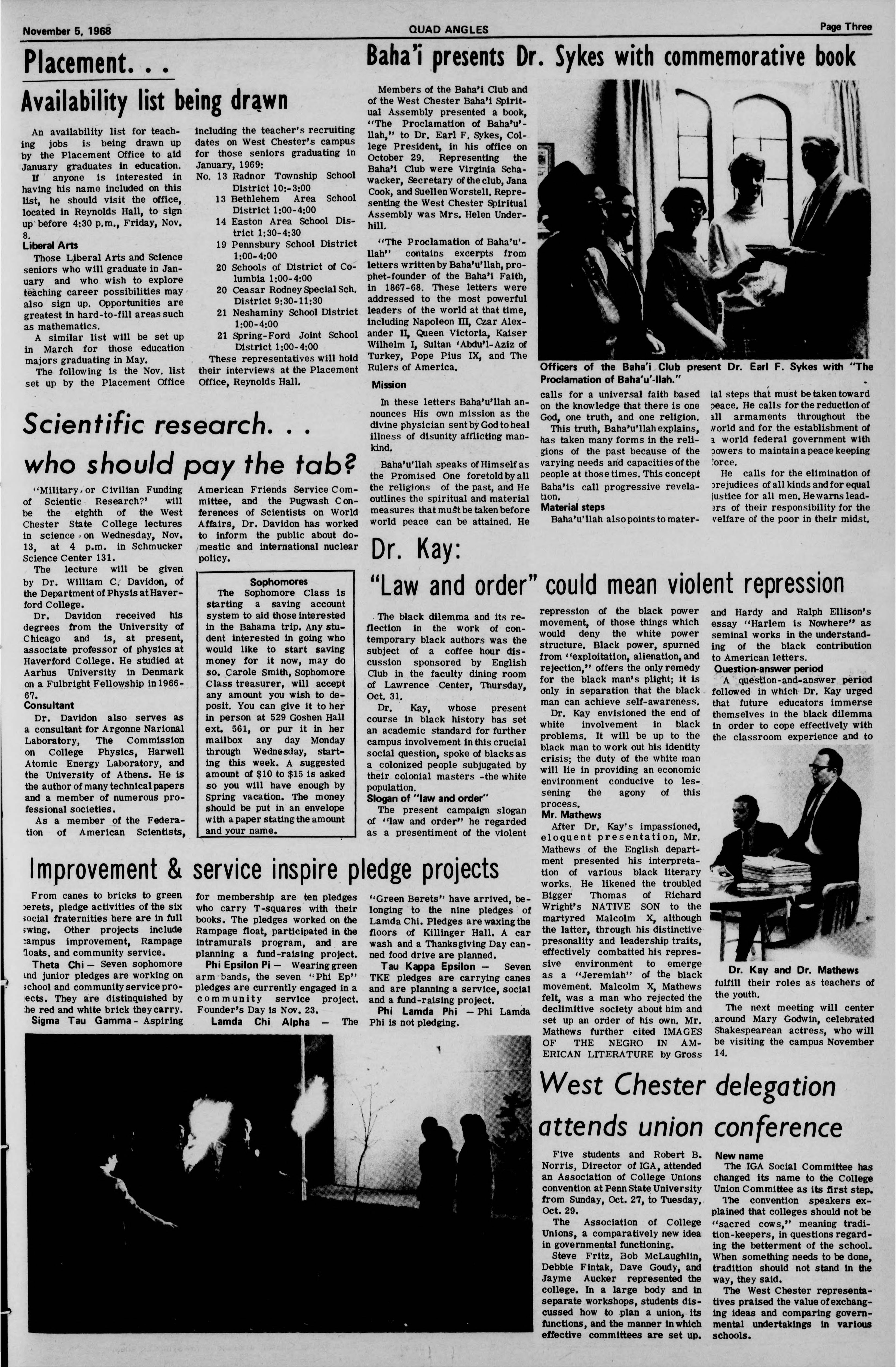
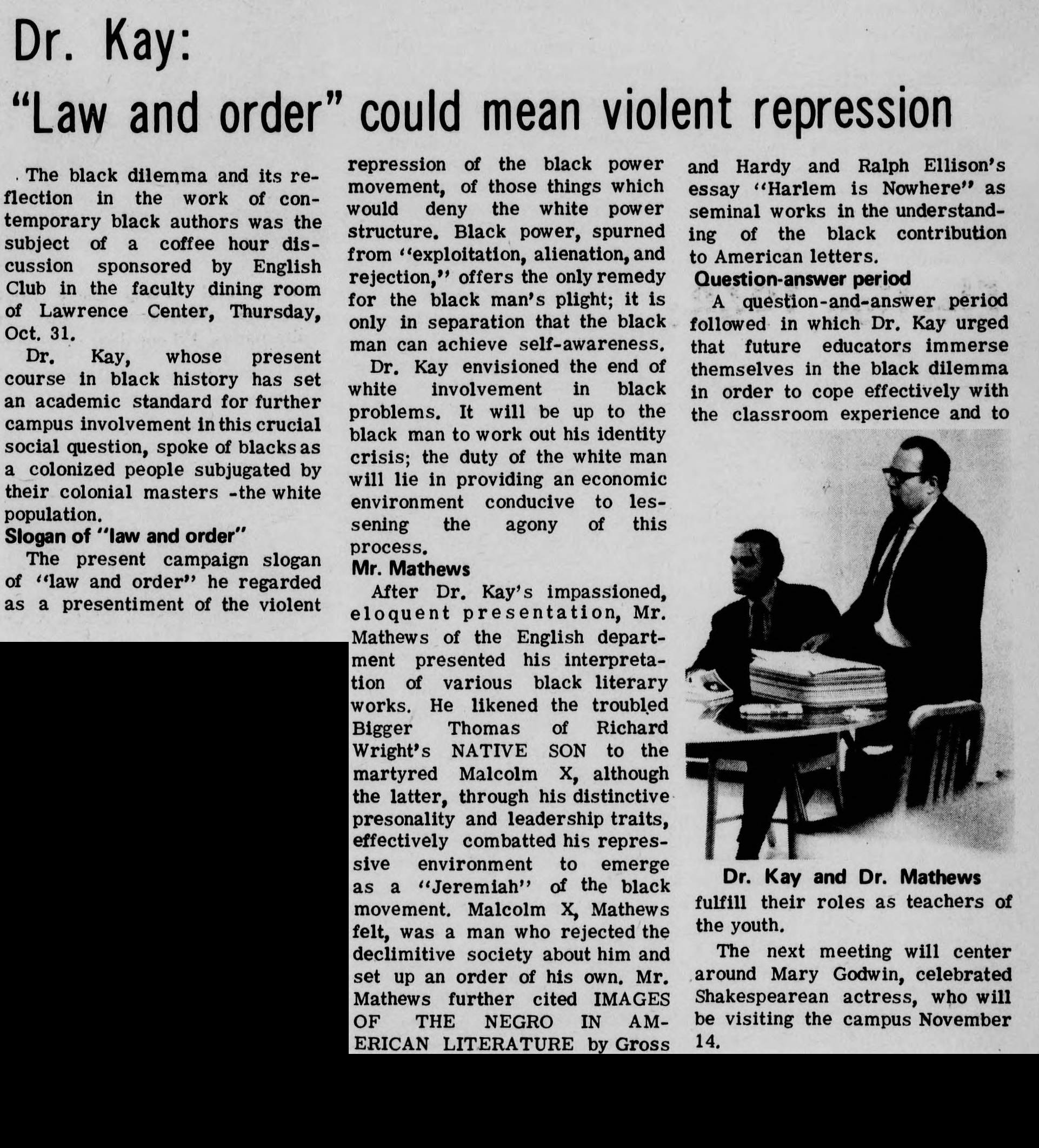
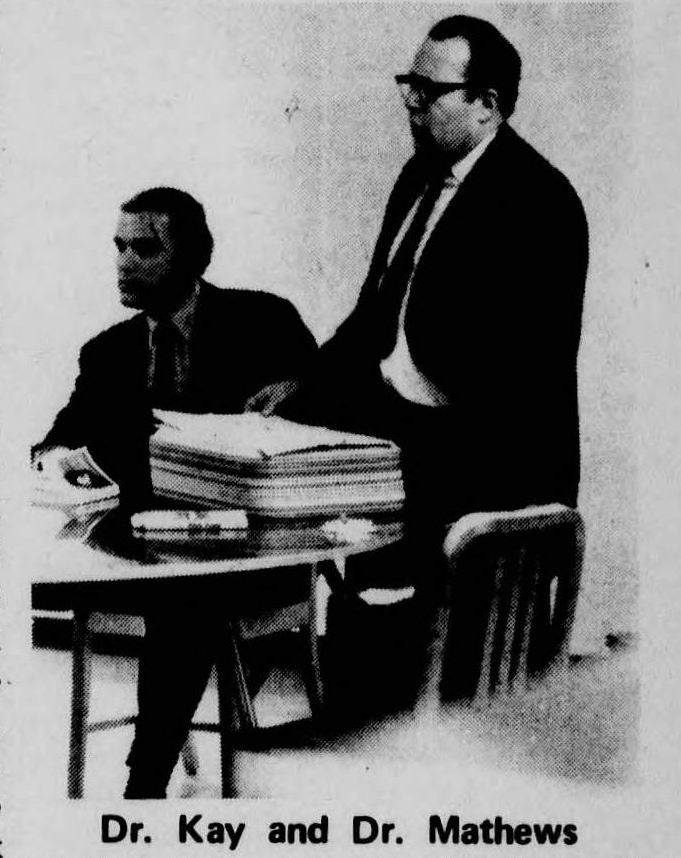
Dr. Kay: "Law and order" The black dilemma and its reflection in the work of contemporary black authors was the subject of a coffee hour discussion sponsored by English Club in the faculty dining room of Lawrence Center, Thursday, Oct. 31. Dr. Kay, whose present course in black history has set an academic standard for further campus involvement in this crucial social question, spoke of blacks as a colonized people subjugated by their colonial masters -the white population. Slogan of "law and order" The present campaign slogan of "law and order" he regarded as a presentiment of the violent could mean violent repression repression of the black power movement, of those things which would deny the white power structure. Black power, spurned from "exploitation, alienation, and rejection," offers the only remedy for the black man's plight; it is only in separation that the black man can achieve self-awareness. Dr. Kay envisioned the end of white involvement in black problems. It will be up to the black man to work out his identity crisis; the duty of the white man will lie in providing an economic environment conducive to lessening the agony of this process. Mr. Mathews After Dr. Kay's impassioned, eloquent presentation, Mr. Mathews of the English department presented his interpretation of various black literary works. He likened the troubled Bigger Thomas of Richard Wright's NATIVE SON to the martyred Malcolm X, although the latter, through his distinctive presonality and leadership traits, effectively combatted his repressive environment to emerge as a "Jeremiah" of the black movement. Malcolm X, Mathews felt, was a man who rejected the declimitive society about him and set up an order of his own. Mr. Mathews further cited IMAGES OF THE NEGRO IN AMERICAN LITERATURE by Gross and Hardy and Ralph Ellison's essay "Harlem is Nowhere" as seminal works in the understanding of the black contribution to American letters. Question-answer period A question-and-answer period followed in which Dr. Kay urged that future educators immerse themselves in the black dilemma in order to cope effectively with the classroom experience and to Dr. Kay and Dr. Mathews fulfill their roles as teachers of the youth. The next meeting will center around Mary Godwin, celebrated Shakespearean actress, who will be visiting the campus November 14.
Files
Reference
1968, Dr. Kay "Law and Order" could mean violent oppression, Special Collections, Francis Harvey Green Library, West Chester University